
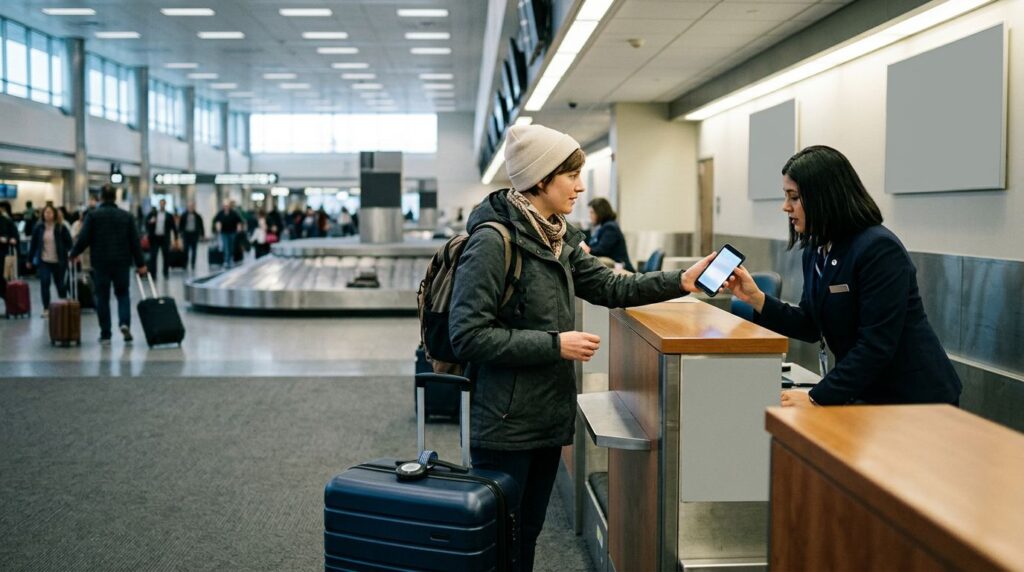

For the last few years, travelers have endured a specific kind of modern torture. You stand at a baggage claim counter, looking at a map on your phone that shows exactly where your suitcase is. Meanwhile, the airline agent types into a terminal and tells you they have no idea where it is. You have the data; they have the logistics. Until now, those two systems refused to talk to each other, leaving passengers with proof of location but no way to force the airline to use it.
Key Takeaways
- More than 10 global airlines now accept Find Hub location links for baggage recovery.
- Shared location links automatically expire after seven days or upon item recovery.
- Find Hub technology is integrated into WorldTracer and NetTracer baggage-tracing systems.
Find Hub is rolling out a new feature designed to close this gap. Users can now generate a temporary, secure link that shares the live location of a tracked item—like a tag inside a suitcase—directly with an airline. Instead of just showing the agent your phone screen, you can feed the location data directly into their recovery systems.
The big deal
The problem with lost luggage usually isn’t that the bag is invisible. The problem is that the consumer tracking networks (like the one on your phone) and the industrial tracking networks (used by airports) operate in parallel universes. This update builds a bridge between them. By integrating with WorldTracer and NetTracer—the backend systems that manage baggage for hundreds of airlines—this feature allows customer data to actually assist in recovery operations.
For the traveler, this moves the process from “arguing with a rep” to “providing actionable data.” If your bag is sitting on a tarmac in Frankfurt while you are in New York, the system can now officially see what you see. It validates the passenger’s claim and gives ground crews a precise target.
How it works
The process is manual but straightforward. You open the Find Hub app, select the missing item, and tap “share item location.” This generates a unique web link. You then copy that link and paste it into the airline’s lost luggage form on their website or app.
Think of it like giving a dog walker a temporary door code to your house. They can use the code to get in and do their job for a set period, but they don’t get a permanent key, and the code stops working once the job is done.
Once the airline has the link, they can view the item’s location on a map as it updates. The link is temporary by design. It automatically expires after seven days or as soon as the system detects the item is back in your possession. You can also manually revoke access at any time if you feel the need to stop sharing.
The catch
This system only works if the airline is set up to receive the data. Currently, the list of partners includes about 15 carriers, such as Lufthansa, Turkish Airlines, Air India, and SAS. Notably absent from the initial list are the major United States carriers. If you are flying with an airline that hasn’t partnered with the program, sending them a link might not trigger the same backend integration.
There is also a time limit. Because the link expires after seven days, a piece of luggage lost for an extended period might require you to generate and send a new link. While this protects privacy, it adds an administrative step for complicated recovery cases.
What to watch
Watch for the expansion of the partner list. Qantas is slated to join soon, but the real test will be if and when major US airlines integrate the feature. Without them, a huge portion of global air travel remains uncovered by this specific tool.
Also, keep an eye on hardware changes. Samsonite is working on embedding Find Hub technology directly into new suitcases. This would remove the need to buy a separate tag entirely. Finally, watch to see if this data actually speeds up return times. Giving airlines the data is step one; whether their ground operations can use it efficiently is step two.