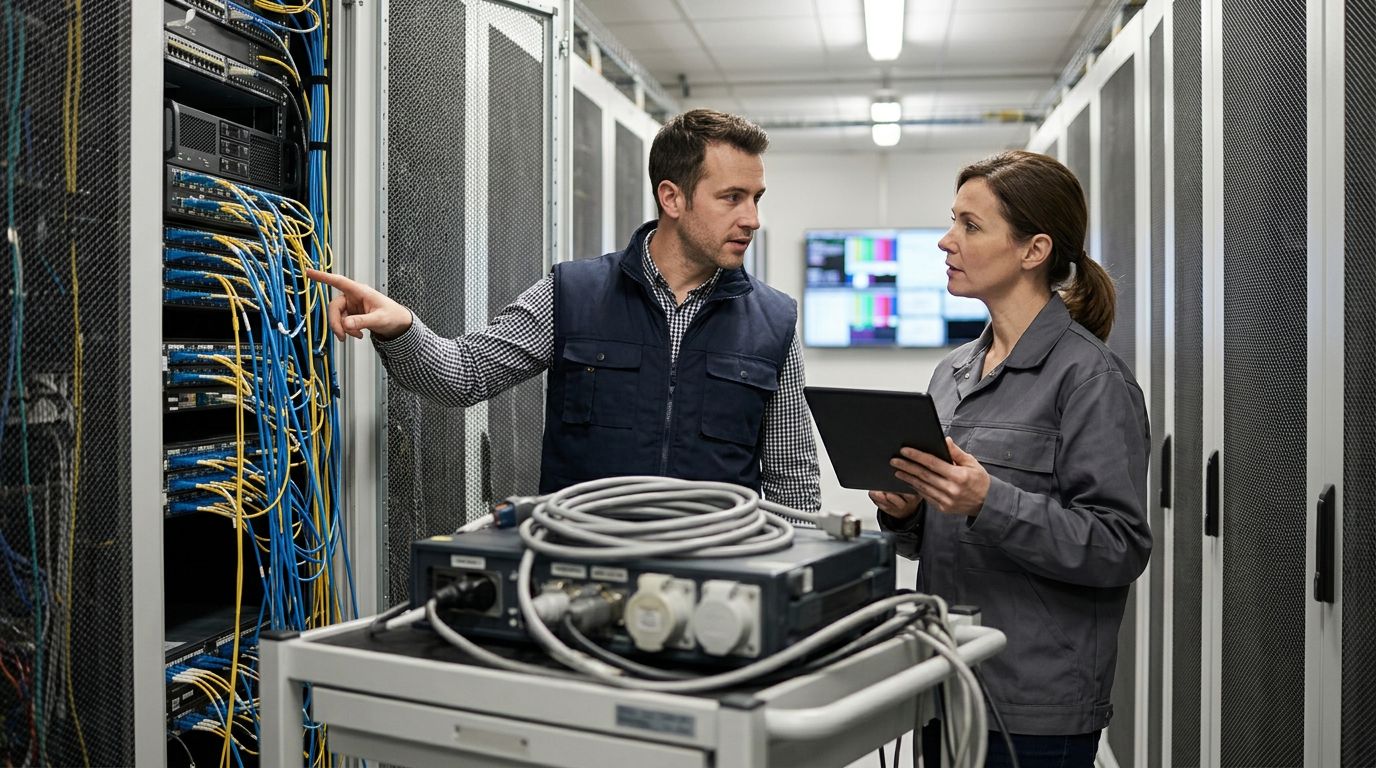
Telecommunications networks are arguably the most complex machines humans have ever built, involving millions of miles of cable and invisible signals that must coordinate perfectly every millisecond. For decades, keeping these systems running required armies of engineers staring at screens, manually tweaking dials when a red light flashed. That era of manual oversight is ending, replaced by software that doesn’t just follow orders but actually decides what to do next.
Key Takeaways
- NVIDIA and AdaptKey AI released an open-source, 30-billion-parameter Nemotron Large Telco Model.
- NVIDIA is releasing its telco AI resources through the GSMA Open Telco AI initiative.
- Cassava Technologies and NTT DATA are implementing NVIDIA’s blueprints for autonomous network configuration.
NVIDIA has released a new artificial intelligence model specifically designed to run phone and data networks. Known as the Nemotron Large Telco Model, it was built with AdaptKey AI and trained on the specific, messy technical language that telecommunications operators use.
The goal here is to move the industry from “automation” to “autonomy.” Automation is a script that restarts a server every Tuesday at midnight. Autonomy is a system that notices the server is overheating, realizes it’s because of a traffic spike, and decides to reroute traffic to a different tower before the server crashes. To do this, NVIDIA is providing blueprints that teach AI agents to think like human engineers.
The big deal
For the average person, this matters because our tolerance for network failure is effectively zero. When a cell tower goes down or data speeds throttle, it usually takes human engineers time to diagnose the problem and type in the fix. An autonomous system can theoretically detect the issue and repair the configuration in seconds, often before you even notice the video buffering.


There is also a significant energy angle. Running 5G networks consumes a massive amount of electricity. Static rules—like keeping all radios on full power during the day—are wasteful. An AI that can reason about traffic patterns can turn power down when no one is using the network and ramp it up instantly when demand spikes, saving money and reducing grid strain without killing your signal.
How it works
The core technology involves “agents”—software programs that can take action—powered by a large language model trained on telecom data. These agents don’t just guess; they follow “reasoning traces,” which are step-by-step logic paths learned from human experts.
Think of the difference between a line cook and a head chef. A line cook (automation) follows a recipe card exactly: chop onions, sauté, serve. If the stove breaks or the onions run out, they stop working. A head chef (autonomy) tastes the soup, realizes it is too salty, and fixes it on the fly, or rearranges the kitchen if a burner dies. They understand the intent of the meal, not just the instructions.
NVIDIA’s system acts like that head chef. It looks at the network’s intent (e.g., “save power” or “fix the outage”). Before it makes a change, it uses a simulation tool to test the action—essentially tasting the soup—to ensure the fix works. If the simulation looks good, the agent applies the change to the real network.
The catch
The primary risk with autonomous systems is the potential for “unintended effects.” If an AI agent makes a bad decision at a network level, it could theoretically cause a wider outage than the one it was trying to fix. The source notes that operators like Cassava Technologies are implementing specific “rollback” agents designed to undo changes if they go wrong, suggesting this is a known operational risk.
There is also a heavy data requirement. To make this work, operators must fine-tune these models on their own proprietary data. While the model itself is open, making it work for a specific carrier requires significant effort to teach the AI the local “dialect” of that specific network’s operations.
What to watch
The industry is moving quickly to test this in the real world. Keep an eye on these specific rollouts:
- Japan: NTT DATA is using this tech to manage traffic surges when users reconnect after an outage.
- Africa: Cassava Technologies is building an autonomous platform to handle multi-vendor networks across the continent.
- Maritime: Telenor Group is adopting these blueprints to manage connectivity for ships at sea.
If you are a customer of these networks, you may soon be relying on an AI to keep your signal strong.