
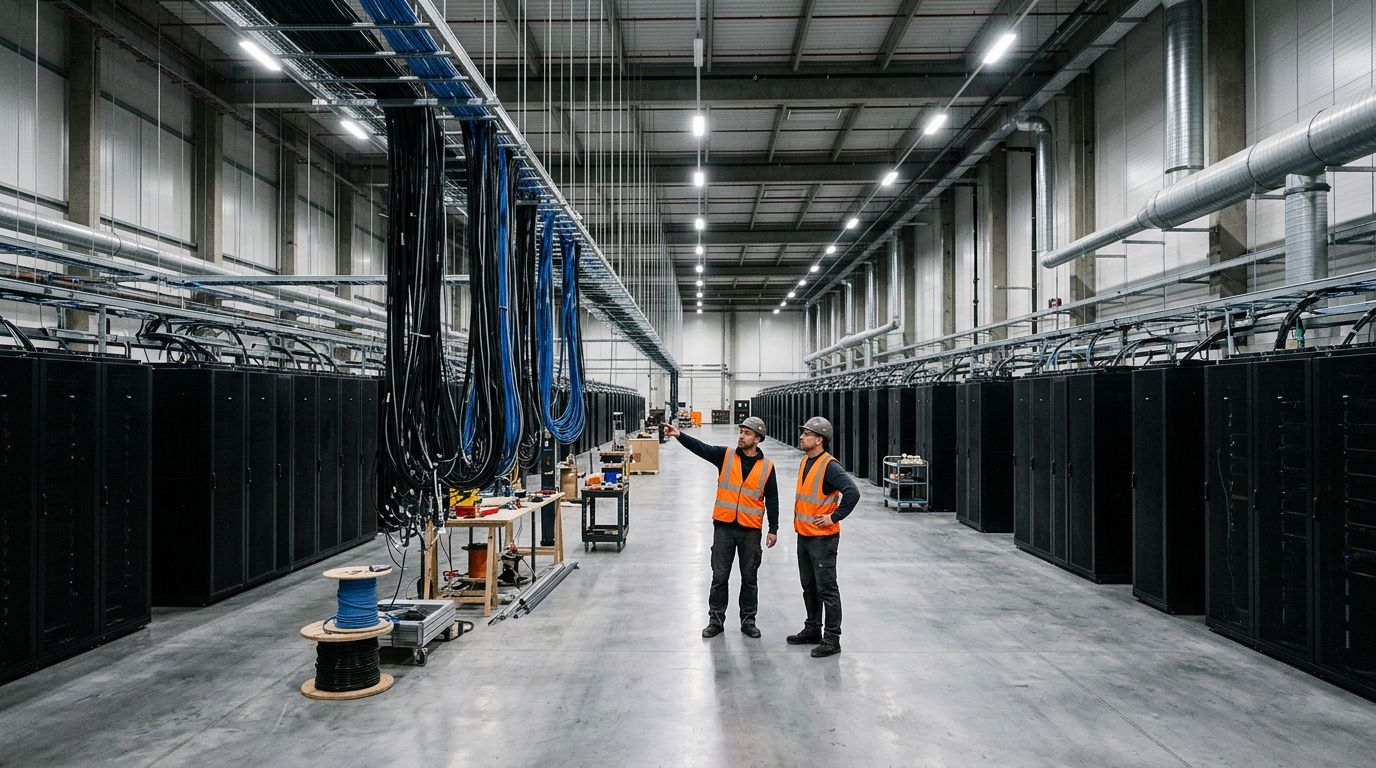
The numbers flying around Silicon Valley this week have stopped looking like corporate budgets and started looking like the GDP of mid-sized nations. Amazon, Google, and Meta are betting hundreds of billions of dollars on a single premise: that computing power will soon be the most valuable resource on Earth. But while tech CEOs are writing the biggest checks in history to build massive data centers, the people holding their stock are starting to ask if anyone actually did the math on when this money comes back.
Key Takeaways
- Amazon projects $200 billion in capital expenditures for 2026.
- Google projects capital expenditures between $175 billion and $185 billion for 2026.
- Meta projects $115 billion to $135 billion in capital expenditures for 2026.
The spending projections released this week are staggering. Amazon leads the pack, estimating it will spend $200 billion in 2026 on capital expenditures. That is a sharp jump from the $131.8 billion it spent in 2025. Google is right behind them, projecting up to $185 billion, while Meta is aiming for a ceiling of $135 billion. Even Microsoft, which hasn’t released an official 2026 number yet, is spending at a rate that suggests they will land near $150 billion.
The logic inside these companies is that whoever owns the most data centers wins. They view high-end computing power as a scarce resource that will determine who survives the next decade. If they don’t build the infrastructure now, they fear they won’t have the capacity to run advanced AI models later.
Wall Street disagrees. When these numbers came out, stock prices for these companies dropped. Investors are looking at the bill and wondering why the payoff is taking so long.


The big deal
This spending spree signals a shift in how the tech industry operates. For years, software companies were loved because they were “asset-light.” They didn’t need factories or heavy machinery to make money; they just needed code. That era is over. AI requires physical infrastructure on an industrial scale.
These companies are now behaving more like utility providers or heavy manufacturers. They are pouring concrete, buying land, and purchasing millions of expensive chips. This matters because it raises the stakes. If the AI boom slows down or doesn’t generate the massive profits these companies expect, they will be left with hundreds of billions of dollars in depreciating hardware.
How it works
The mechanism driving these costs is “capital expenditure,” or capex. This is money a company spends to buy, maintain, or improve its fixed assets, like buildings or servers.
Think of it like opening a massive chain of pizzerias. You have to buy the real estate, build the kitchens, and install the ovens (the data centers and chips) long before you sell your first slice (the AI service). If you build too small, you can’t feed the lunch rush and lose customers to the guy across the street. If you build too big and nobody shows up, you go broke paying for empty kitchens.
Right now, Amazon, Google, and Meta are building the biggest kitchens in history, assuming the entire world is about to get very hungry. They are paying for the land and equipment today, hoping the revenue follows tomorrow.
The catch
The immediate problem is that investors hate uncertainty. While the tech giants see this as a necessary war for survival, shareholders see it as burning cash. The stock drops this week show that the market is losing patience with the “build it and they will come” strategy.
There is also a lack of clarity on where the money is actually going. Amazon, for instance, has a massive physical logistics network. Their $200 billion figure includes spending on warehouses, robotics, and satellites, not just AI. It is difficult to separate how much is being spent on delivery trucks versus data centers, making it harder to judge the wisdom of the investment.
Microsoft faces a different issue. While they are currently in third place for projected spending, their CEO Satya Nadella is already facing pressure from investors to justify the costs. The catch for everyone is that the price of entry for AI keeps going up, but the profits are not scaling at the same speed.
What now?
Do not expect these companies to stop spending. The fear of being left behind is stronger than the fear of angry investors. However, expect the executives to change how they talk about it. Going forward, they will likely try to downplay the total cost or aggressively highlight how these investments are already saving money elsewhere.
If you are an investor, watch the profit margins, not just the revenue. The real test will be whether these companies can maintain their profitability while dragging the weight of this massive infrastructure build-out. The next few quarters will reveal if these data centers are gold mines or money pits.