
The FDA approves about 50 new drugs a year. That number has remained stubbornly low even as our understanding of genetics has exploded. We possess the tools to edit life, yet we lack the raw human processing power to apply them to thousands of rare diseases. Two biotech companies are now arguing that the only way to break this bottleneck is to stop relying on human scientists to do the heavy lifting.
Key Takeaways
- GenEditBio received FDA approval for CRISPR therapy trials targeting corneal dystrophy.
- Insilico Medicine launched the MMAI Gym to train generalist large language models for pharmaceutical tasks.
- The FDA approves an average of 50 new drugs every year.
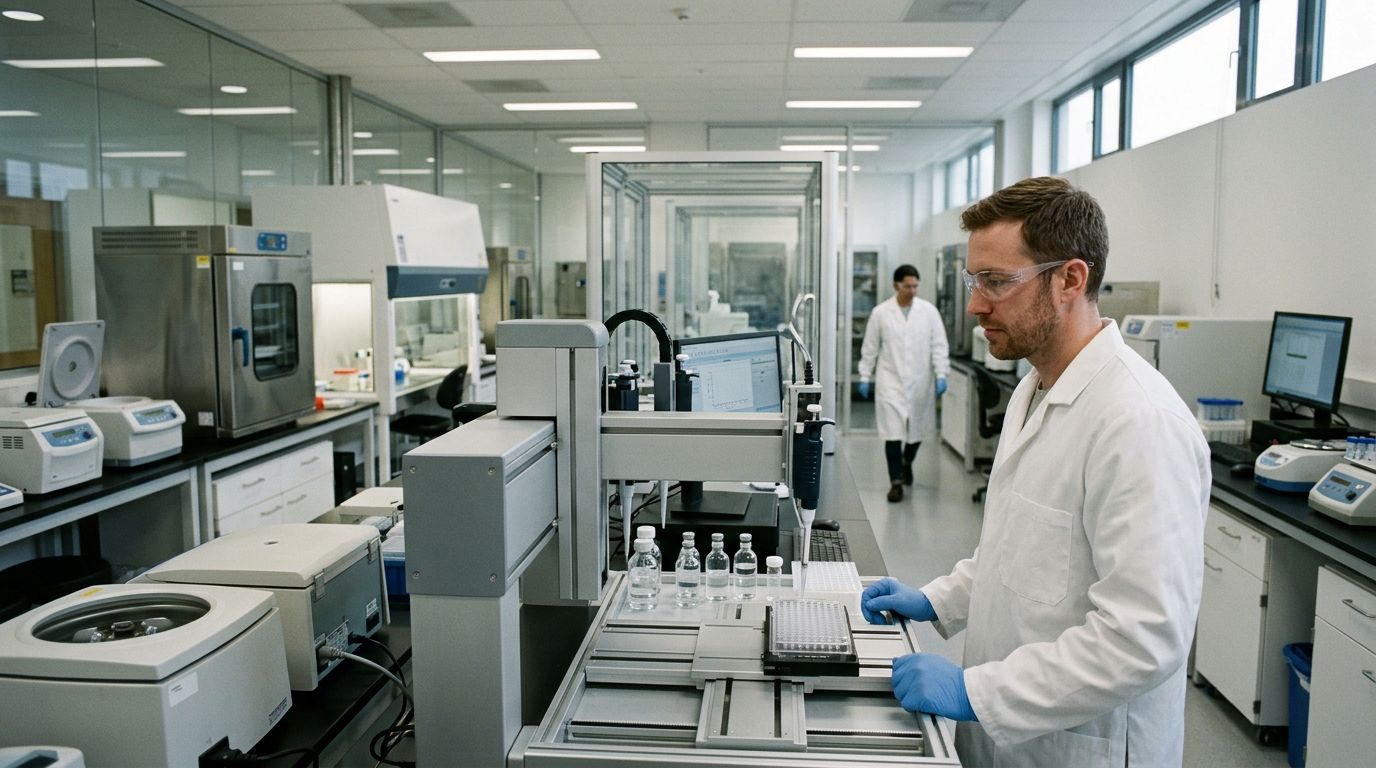
Insilico Medicine and GenEditBio are pitching AI as a “force multiplier” for biology. Insilico is building what it calls a “pharmaceutical superintelligence.” They recently launched a training system called MMAI Gym. It teaches AI models to handle multiple drug discovery tasks at once. The goal is to automate the hypothesis work that usually requires armies of chemists.
GenEditBio is tackling a different problem. They want to make gene editing a simple injection. Instead of taking cells out of the body to fix them, they use AI to design vehicles that carry the cure directly to the right tissue inside the patient.
The big deal
Rare diseases are often a numbers game. Developing a new drug costs billions, so pharmaceutical companies usually focus on common conditions where they can recoup that investment. Thousands of rare disorders are left untreated because the economics do not work. If AI can automate the labor-intensive parts of discovery, the cost drops. This could make it profitable to cure diseases that the industry has historically ignored.


There is also a major shift in how treatments are delivered. Current gene therapies often require “ex vivo” editing. Doctors extract cells from a patient, edit them in a lab, and put them back. This is slow, expensive, and hard to scale. GenEditBio is pushing for “in vivo” treatments—a single injection that does the work inside the body. This approach turns a complex medical procedure into something closer to a standard prescription, making it far more accessible globally.
How it works
Think of gene therapy like sending a fragile glass vase to a specific apartment in a massive, guarded high-rise. You have the vase (the cure), but you do not know the door code, and the building security (your immune system) destroys anything it does not recognize.
GenEditBio uses AI to design the delivery truck. The company has a library of thousands of nanoparticles. Their AI analyzes chemical structures to predict which vehicle can slip past the immune system and park exactly at the right organ, like the eye or liver. It tests these predictions in a lab, learns from the failures, and refines the design for the next round.
Insilico applies a similar logic to the drug molecule itself. Their platform ingests clinical and biological data to generate hypotheses. It predicts which molecules might work against a disease, automating a process that typically relies on human intuition and trial and error.
The catch
AI models are only as good as the data they consume, and biology has a data problem. Insilico’s CEO notes that current medical datasets are heavily biased toward Western populations. If an AI learns primarily from data generated in the West, the resulting drugs may not work as well for patients in other parts of the world.
There is also a shortage of “ground truth” data—verified facts from real patients. You cannot perfectly simulate human biology yet. While Insilico is working on “digital twins” to run virtual clinical trials, they admit this technology is still in its infancy. The industry still needs to verify AI predictions in the real world, which remains slow and expensive.
What now?
GenEditBio has received FDA approval to start trials for a treatment for corneal dystrophy. This will be a concrete test of their delivery technology in human eyes. Insilico is focusing on expanding its automated labs to generate more clean data.
If you follow the pharmaceutical industry, look for whether the annual approval rate for new drugs actually rises above 50 in the coming years. That number is the only metric that matters.