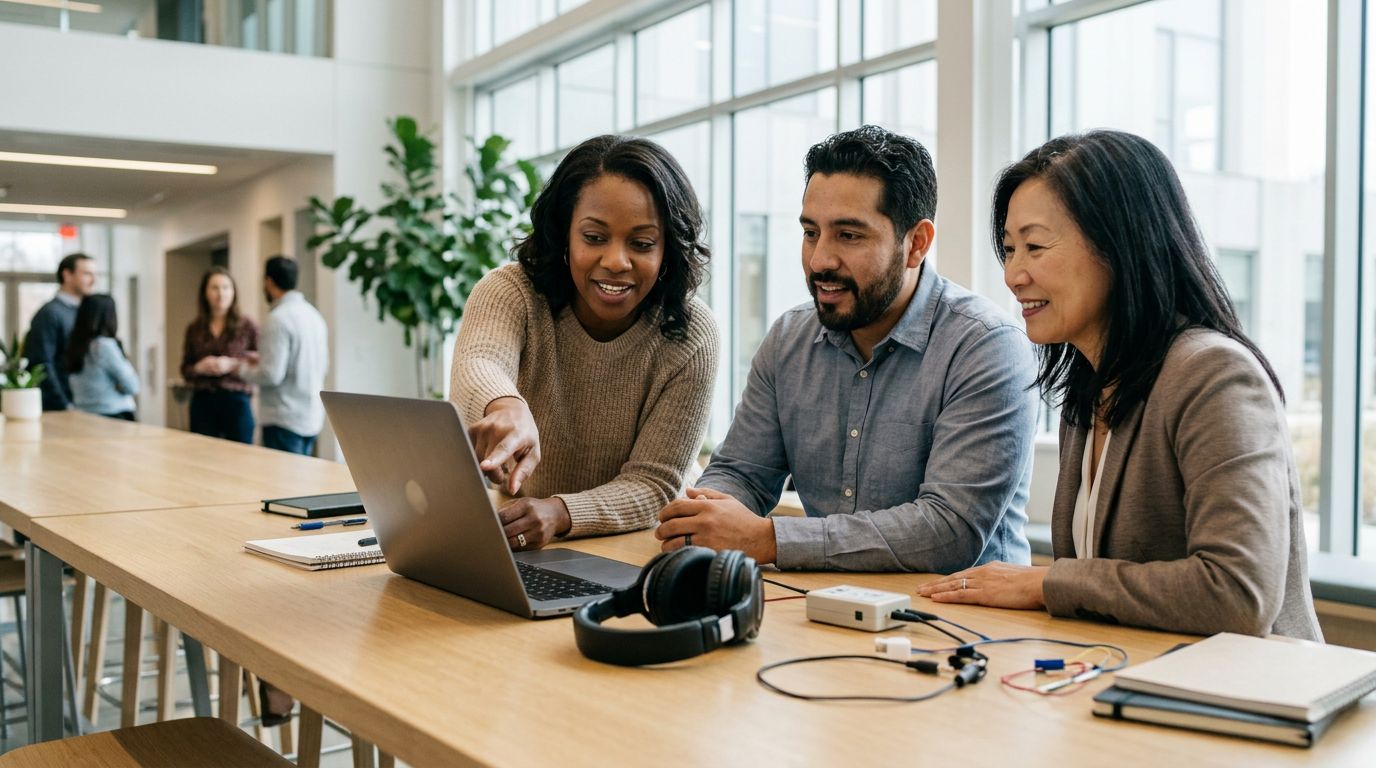
It usually takes a computer science degree to build an app that visualizes food thermodynamics or animates Shakespeare. But last week, a culinary teacher from Montana and an English teacher from Guam did exactly that without writing a single line of traditional code. They were part of a group of 56 educators gathered in Mountain View to test a specific idea: that the main barrier to custom educational software is no longer technical skill.
Key Takeaways
- Fifty-six 2026 State Teachers of the Year attended an onboarding session at Google’s campus.
- The Council of Chief State School Officers provides a year-long professional development program for educators.
- Educators used Gemini to build custom software, including motion-based music tools and animated literature.
The event served as the kickoff for the 2026 National Teacher of the Year Program, organized by the Council of Chief State School Officers. Fifty-six teachers—one from each state and territory—spent time at Google’s campus. The agenda focused on “vibe coding,” a casual term for using AI models to generate software applications through natural language prompts.
Instead of learning Python or JavaScript, these educators used Gemini to describe the tools they needed. The AI then wrote the code to build them.
The big deal
Educational software is often one-size-fits-all. A textbook publisher in New York rarely accounts for the specific cultural context of a classroom in Guam or the specific learning challenges of a single student in a music class. This usually leaves teachers stuck with generic tools that do not quite fit their needs.

This shift to natural language programming allows teachers to build “micro-software.” An English teacher created an animated version of Macbeth featuring characters in traditional Guamanian clothing. A music teacher built a motion-based tool for students who struggle with standard instruments. A culinary instructor built a simulation for food science thermodynamics.
The value here is specificity. These tools would likely never be built by a commercial software company because the market for them is too small. But for those specific classrooms, they are exactly what is needed.
How it works
The core mechanism is generative coding. You type a description of a program, and the AI writes the executable code to create it.
Think of it like ordering a custom sandwich at a deli counter. You do not need to know how to bake the bread, cure the meat, or slice the cheese; you just tell the person behind the counter exactly what you want, layer by layer, and they assemble the final product for you.
In this scenario, the teacher provides the instructions in plain English, and the AI handles the technical assembly of the code.
The catch
The source text does not address the practical limitations of these tools. It does not mention who owns the software created, whether there are costs associated with hosting these custom apps, or if student data privacy is protected when using them.
Reliability is also an open question. The text does not say how often the AI code failed, required debugging by a human engineer, or if the teachers could fix the apps if they broke later.
What to watch
This was an onboarding session for a year-long professional development program. The real test is whether these prototypes survive contact with actual classrooms.
- Durability: Will the apps built in a workshop continue to function months from now without maintenance?
- Adoption: Watch to see if this “vibe coding” approach spreads to teachers outside this elite cohort.
- If you are a teacher: Look for updates on how these tools handle student data before building your own.